Leroy Merlin
Executive Summary
Leroy Merlin partnered with us to design and develop the
Leroy Merlin Shopping Application (LMSA) — a
cloud-native, microservices-driven ecommerce platform
designed to handle peak retail loads and provide a secure, real-time
shopping experience.
The application leverages AWS-managed services and an event-driven
synchronization framework (SyncFactory) to maintain product, order, and
stock data in real time across web and mobile applications. With its
resilient multi-AZ deployment, a hybrid data strategy (Aurora PostgreSQL,
MongoDB, Redis, OpenSearch), and embedded security/compliance controls, LMSA
enables:
- • Scalable product catalog management with dynamic updates
-
• Secure omni-channel payments (PayFast, SnapScan, Apple Pay, Samsung Pay)
-
• Real-time personalization and search with OpenSearch + Dynamic Yield AI
-
• Sub-second response times during peak catalog and checkout operations
From the outset, security, resilience, and cost governance were foundational
requirements. The application demonstrates enterprise-grade reliability
(99.99% SLA), while embedding defense-in-depth security measures spanning
identity, infrastructure, compliance, and auditing.
By building on AWS services such as ECS Fargate, Aurora PostgreSQL, Redis,
OpenSearch, CloudFront, WAF, GuardDuty, Config, KMS, and CloudWatch, LMSA
delivers production-grade resiliency and scalability — setting a new
benchmark for largescale e-commerce adoption in retail environments.
Project Overview
LMSA addresses Leroy Merlin’s need to deliver a next-generation digital
shopping platform with the following goals:
-
• Ensure data synchronization between legacy ERP, product catalogs, and
modern APIs
-
• Deliver real-time inventory & pricing across both web and mobile
channels
- • Provide secure, multi-method digital payments and refunds
-
• Enable search, personalization, and recommendations at cloud scale
-
• Support admin workflows for regional store managers and central super
admins, with role-based governance
Core Technical Objectives
-
• Resilience and Concurrency Handling at Scale
-
o Seamless operation during seasonal sales with thousands of orders
per minute
-
o Hybrid sync (polling + webhooks) with retries to prevent data loss
-
o Auto-scaling microservices ensuring smooth operations during traffic
surges
-
Omni-Channel Real-Time Experience
- o Real-time search indexing with OpenSearch
- o Recommendations powered by Dynamic Yield AI
- o Unified product catalog across channels
-
• Enterprise-Grade Security and Compliance
- o IAM least-privilege roles with SCP guardrails
- o End-to-end encryption via AWS KMS + TLS 1.2+
-
o Continuous compliance monitoring with AWS Config + Security Hub
-
Operational Excellence and Cost Efficiency
-
o IaC-driven deployments with Terraform + Jenkins Blue/Green pipelines
- o Observability with Prometheus, Grafana, CloudWatch
-
o FinOps practices for right-sizing and storage/cost optimization
Solution Design
LMSA is architected as a modular, event-driven, microservices platform that
leverages AWS-managed services with security and operational resilience
baked in. The solution emphasizes real-time updates, fault isolation,
observability, and compliance automation, ensuring a smooth end-user
experience and operational scalability.
Core Architectural Principles
-
Event-Driven Middleware (SyncFactory)
-
Hybrid sync with agenda-based polling for scheduled updates and
real-time webhooks for critical events (stock, price, order).
- Dead Letter Queues (DLQ) with retries ensure zero data loss.
-
Prometheus metrics + Grafana dashboards provide real-time sync
observability.
-
CQRS Design
-
Commands (create/update/delete) and Queries (reads/searches) decoupled
for scalability.
-
Queries use Redis caching and OpenSearch indexing for sub-100ms
responses.
- Event-driven updates maintain integrity across databases.
-
Decoupled Microservices
- AppBackend Service: API orchestration for mobile/web.
-
Payment Service: Secure integration with regional payment gateways.
- SyncFactory Service: Orchestrates synchronization logic.
-
CMS/Admin Services: For catalog, order, refund, and promotions
management.
-
Hybrid Data Strategy
- Aurora PostgreSQL (RDS) → structured, transactional workloads.
- MongoDB → unstructured CMS/product metadata.
- Redis → caching + pub/sub for instant updates.
- OpenSearch → full-text, multi-lingual search + personalization.
-
Observability and Resilience
- IaC Blue/Green Deployments with Terraform + Jenkins.
- Prometheus + Grafana + CloudWatch alerting.
- Disaster recovery testing with AWS Fault Injection Simulator.
- Multi-AZ HA with RTO < 30 mins, RPO < 5 mins.
Technical Implementation Overview
The Leroy Merlin Shopping Application (LMSA) is implemented using a
containerized, microservices-based design hosted on AWS ECS Fargate, with a
layered data and sync model ensuring real-time accuracy across products,
stock, and orders.
1. Ingestion Layer – SyncFactory Middleware
a. Webhook Listeners capture critical updates (stock, orders, price changes)
from external ERP and payment gateways, instantly pushing into queues.
b. Polling Jobs (Agenda-based) retrieve bulk catalog, product, and category
updates on configurable intervals.
c. Both ingestion paths feed into Amazon SQS Queues (FIFO with DLQs) to
guarantee ordered, deduplicated processing.
2. Processing & Command Layer
a. CQRS pattern separates write operations (inventory updates, order
placement, payment confirmations) from read operations (product queries,
catalog retrieval).
b. Command Handlers update Aurora PostgreSQL (transactional consistency).
c. Event notifications trigger updates to Redis/OpenSearch for fast reads.
d. Dead-Letter Queues capture failed transactions, retried automatically
with exponential backoff.
3. Storage Layer
a. Aurora PostgreSQL (Multi-AZ + RDS Proxy): Handles all critical
transactional entities — orders, invoices, registered users. PITR enabled
for recovery.
b. Redis (Clustered): In-memory cache layer for session data, stock counts,
and popular products. Sub-50ms cart retrieval
c. MongoDB Atlas: Stores unstructured and CMS-driven product metadata
(marketing text, FAQs, configurations)
d. Amazon OpenSearch: Optimized for product discovery with real-time
indexing → driving search, recommendations, and promotions.
4. API/Orchestration Layer
a. AppBackend (ECS Fargate): REST/GraphQL APIs handling client requests from
mobile and web apps. Orchestrates data fetches across SyncFactory, Redis,
Aurora, and OpenSearch.
b. Payment Service: Independent service integrating with PayFast, SnapScan,
Apple Pay, Samsung Pay. Event-driven confirmations handled asynchronously.
c. CMS/Admin APIs: Provides store managers and super admins with the ability
to manage stock, approve refunds, and create promotions — enforced with
role-based access control via IAM.
5. Delivery Layer
a. Amazon CloudFront: Delivers static assets globally with low latency.
b. Application Load Balancers (ALB): Route client traffic to the correct ECS
microservices.
c. Redis Pub/Sub + OpenSearch Index Updates: Facilitate instant propagation
of catalog and stock changes for consistent end-user experience.
6. Observability Layer
a. Prometheus + Grafana Dashboards: Track sync throughput, queue latency,
Redis cache hits/misses, database load.
b. Amazon CloudWatch Logs & Metrics: Store structured logs from ECS tasks
for troubleshooting.
c. Alerting: SNS integrates with Teams/Slack for critical thresholds (queue
backlog >10%, API error rate >2%, Redis replication lag >5s).
Reliability & Recovery Layer
a. Blue/Green deployments managed with Jenkins + Terraform pipelines.
b. Multi-AZ failover for Aurora and Redis ensures resilience.
c. RTO < 30 minutes; RPO < 5 minutes validated in monthly AWS FIS resilience
drills.
d. Automated backup restoration procedures validated quarterly.
Architecture Diagrams
High-Level System Flow
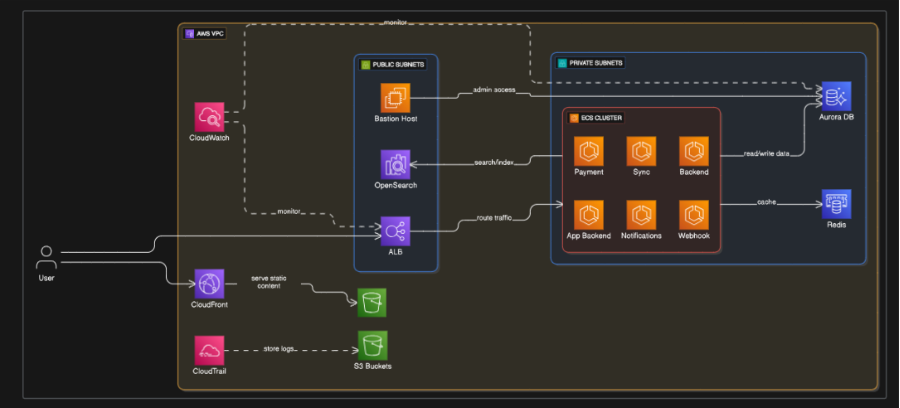
All user traffic enters LMSA through Amazon CloudFront, secured with AWS WAF
managed rules and AWS Shield Standard for DDoS protection. Requests reach an
Application Load Balancer (ALB), which distributes them to containerized
services running on AWS ECS Fargate.
-
• SyncFactory Middleware orchestrates product/stock synchronization via
API polling + webhooks.
-
• Aurora PostgreSQL handles transactional data (orders, customer
accounts).
-
• Redis Cluster accelerates query responses and manages shopping
cart/stock caching.
-
• OpenSearch indexes products in near-real-time for fast multilingual
search.
-
• MongoDB (Atlas) stores unstructured content (product descriptions, CMS
data)
SyncFactory and Middleware Architecture
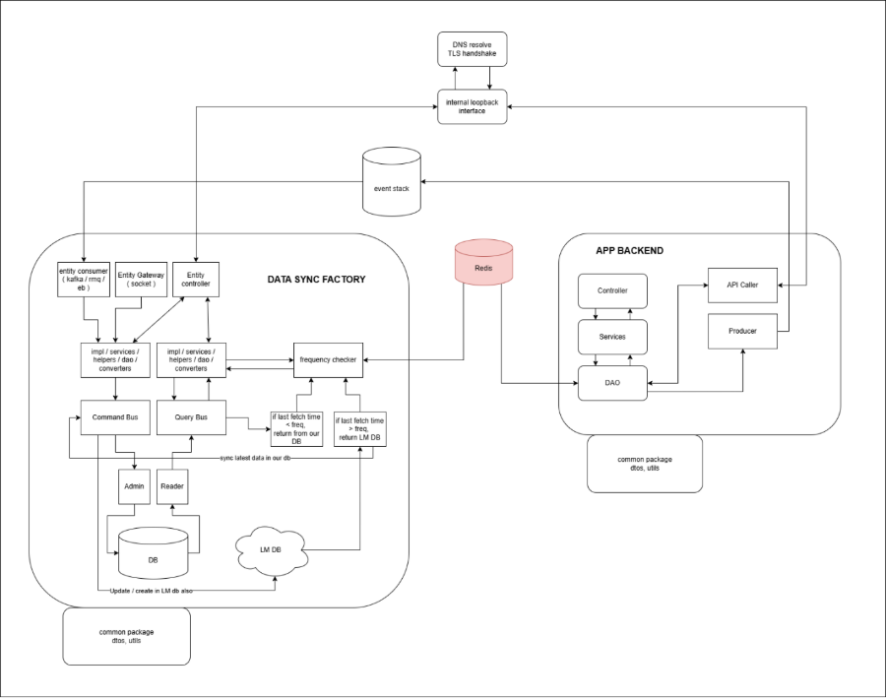
Product, stock, and pricing updates follow a two-path mechanism:
- Polling Updates: Scheduled jobs fetch bulk updates from ERP APIs.
-
Webhook Updates: Instant updates for “critical” changes (price drops,
stock changes, order confirmation).
All updates move through SQS Queues with DLQs for failed messages,
guaranteeing at-least-once delivery. SyncFactory writes events into Aurora
(transactions) or OpenSearch (search index) while redistributing hot paths
to Redis.
This ensures zero data loss, elastic scaling, and a real-time marketplace
experience during peak events.
Security and Audit Architecture
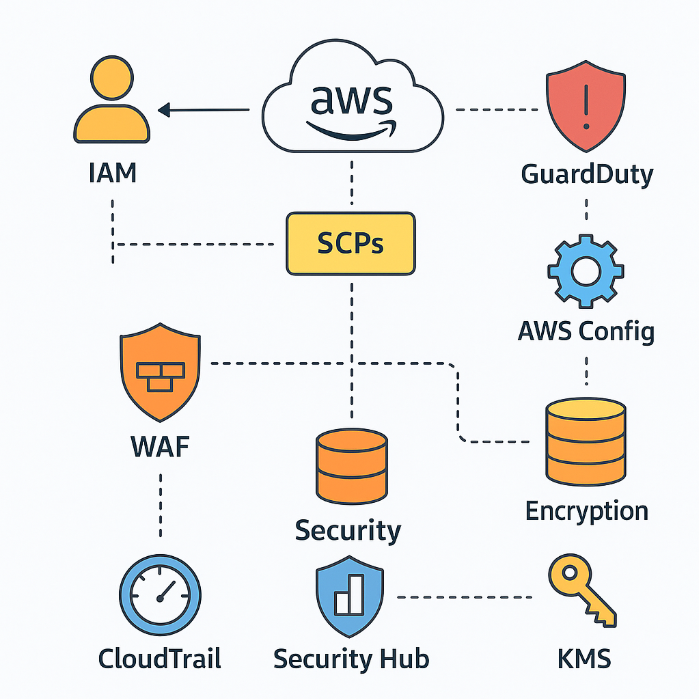
LMSA integrates defense-in-depth security protections across application,
infrastructure, and identity layers:
- AWS WAF + Shield block malicious traffic (SQLi, DDoS).
-
IAM roles with least privilege + SCP guardrails enforce safe access.
-
KMS encryption for Aurora, Redis, SQS, and S3 guarantees
encryption-at-rest.
- TLS 1.2+ enforced for encryption-in-transit.
-
AWS Config + Security Hub continuously validate compliance against
CIS/FSBP baselines.
Security is reinforced with CloudTrail logging, Config conformance packs,
and automated remediation via SSM Runbooks.
Application Security
- API endpoints gated via WAF + Shield + TLS/HTTPS.
- CI/CD pipelines use Trivy scanning for container images.
- Static + dynamic security testing performed in PR pipelines.
-
Zero secrets stored in images — all credentials rotated via AWS Secrets
Manager.
Production outcome: LMSA blocked all detected SQLi/XSS attempts during load
tests; maintained “zero downtime” resilience during synthetic DDoS drills.
Identity & Access Management (IAM)
- Terraform-defined IAM roles enforce least privilege.
- AWS SSO (IAM Identity Center) → MFA for all admin roles.
-
Service Control Policies (SCPs) prevent accidental high-risk actions (e.g.
deleting KMS keys).
-
Just-In-Time access model for senior engineers, with auto-expiry and
CloudTrail review.
Production outcome: 100% MFA adoption, reduced admin privileges by >80%,
zero credential leak incidents.
Infrastructure Protection
-
VPC segmentation across multiple AZs, with public, private, and isolated
subnets.
- Security Groups narrowly scoped; NACLs restrict egress.
- VPC endpoints for private AWS service communication.
-
Monthly FIS chaos drills validate blast radius + failover scenarios.
Compliance and Privacy
-
AWS Config conformance packs enforce encryption at rest,
MFA, secured SGs, proper tagging.
-
Logs routed to S3 buckets with Object Lock + encryption.
-
KMS-backed key encryption with rotation policies on all stores (Aurora,
Redis, SQS, S3).
-
Continuous audit evidence captured via Audit Manager for
SOC2-like controls.
Outcome: Reduced compliance-report prep time by ~60%
Threat Detection & Response
-
GuardDuty + Security Hub continuously detect threats.
-
Findings → event-driven workflow via
EventBridge → SNS → Microsoft Teams.
-
SSM runbooks auto-remediate common risks (open SGs, IAM
drift, public S3 buckets).
-
Third-party SIEM (Datadog) ingests CloudTrail + WAF + host agent logs for
correlation.
Outcome: MTTR < 5 minutes; eliminated all high-risk
unresolved misconfigs within SLA
Cloud Operations
Controls-as-Code
All preventive, detective, and corrective controls are implemented as code.
Terraform modules enforce
encryption, VPC network segmentation, IAM baselines, and tagging
standards. CI/CD pipelines (Jenkins/GitHub Actions) integrate
Trivy + policy-as-code scanners to block noncompliant
images/templates. AWS Config + Security Hub continuously
detect drift, misconfigurations, and nonconformance, while
AWS SSM Automation applies safe remediations with approval
workflows for sensitive actions.
Cloud governance for LMSA is implemented to ensure
security, compliance, cost efficiency, operational transparency, and
resilience
— all tailored to the needs of a high-scale digital shopping
application.
-
Identity & Access Management (IAM) and Policy Control
-
IAM roles scoped per microservice (AppBackend, Payment,
SyncFactory, CMS/Admin).
-
Enforced least privilege access across ECS tasks, Aurora,
Redis, MongoDB Atlas, and OpenSearch.
-
Terraform-managed IAM policies ensure consistent
baselines.
-
AWS Organizations Service Control Policies (SCPs)
restrict sensitive actions (iam:*, kms:*).
-
AWS IAM Identity Center (SSO) federates human access, MFA
enforced for all admins.
-
Primary admin access via
SSM Session Manager (no inbound SSH, no static keys).
- Break-glass access role vaulted, time-boxed, and tested quarterly.
- Configuration Compliance and Auditing
-
AWS Config conformance packs (CIS AWS Foundations 1.5, AWS
FSBP)
applied across Dev/QA/Prod accounts, aggregated organization-wide.
-
Multi-Region AWS CloudTrail enabled with
KMS encryption + S3 Object Lock (Compliance mode), log
integrity validation, and 1-year retention.
-
Violations routed via
EventBridge → SNS → Microsoft Teams.
-
Automated remediation by SSM Automation for common issues
(unencrypted volumes, open SGs, missing tags).
-
Quarterly IAM usage reviews validate permissions against Config timelines
+ CloudTrail evidence.
- Infrastructure-as-Code Governance
- Standard Terraform modules enforce:
- Tagging (Environment, Owner, Stage)
- KMS-backed encryption for Aurora, MongoDB, Redis, SQS, and S3
- Network baselines (VPC, subnets, NACLs, Security Groups)
-
CI/CD pipelines run
terraform validate + Trivy scans against IaC and
containers; failed builds block merges.
-
Policy-as-code gates (OPA/Checkov) integrated into PRs
→ mandatory 2-reviewer approvals.
-
Daily drift checks compare Terraform plan vs Config
timelines; drift remediated or ticketed as exception with time limit.
- Infrastructure-as-Code Governance
- Standard Terraform modules enforce:
- Tagging (Environment, Owner, Stage)
- KMS-backed encryption for Aurora, MongoDB, Redis, SQS, and S3
- Network baselines (VPC, subnets, NACLs, Security Groups)
-
CI/CD pipelines run
terraform validate + Trivy scans against IaC and
containers; failed builds block merges.
-
Policy-as-code gates (OPA/Checkov) integrated into PRs
→ mandatory 2-reviewer approvals.
-
Daily drift checks compare Terraform plan vs Config
timelines; drift remediated or ticketed as exception with time limit.
- Cost Governance and Budget Controls
- AWS Budgets with thresholds + anomaly detection.
-
Compute Optimizer + monthly FinOps reviews prune idle ECS
tasks, snapshots, and EBS volumes.
-
Tag-based cost categories map spends to features,
regions, and teams — enabling chargeback/showback.
- Resilience and Disaster Preparedness
-
S3 Cross-Region Replication ensures asset/config backup.
-
Aurora PostgreSQL automated snapshots + PITR, Redis snapshotting, and
MongoDB Atlas backups.
-
AWS Fault Injection Simulator (FIS) runs monthly chaos
tests (queue delays, ECS outages, Aurora failover).
-
SSM Runbooks automate recovery tasks (restart ECS,
re-apply SGs, enforce encryption).
-
Checkpointing at SyncFactory + EMR batch processes ensure
deterministic recovery of catalog ingestion jobs.
- Compliance and Operational Oversight
-
KMS enforced for all data-in-transit and at-rest paths
across Aurora, Redis, SQS, MongoDB, S3.
-
AWS WAF + AWS Shield Standard protect ingress layers.
-
Security Hub aggregates GuardDuty, Config, and third-party SIEM
alerts
into a unified security view.
-
CI/CD pipelines (Jenkins) integrate Trivy + policy-as-code checks;
critical issues block promotion.
-
Monthly compliance and security reports summarized into a Governance
Dashboard reviewed in Infra/FinOps councils.
Compliance and Auditing
Methodology and Process for Compliance and Auditing
We conduct
discovery workshops aligned to SOC 2 Security & Availability, mapping LMSA’s in-scope services —
ECS Fargate (microservices), SQS FIFO (sync queues), Aurora PostgreSQL,
Redis, MongoDB Atlas, OpenSearch, CloudFront/S3
— along with data flows, regional replication policies, and retention
requirements.
Outputs are consolidated into a compliance control catalog,
which is then translated into
infrastructureascode (IaC) guardrails and
monitoring policies.
A joint RACI defines responsibilities for:
- CloudTrail multiregion logging
- KMS key lifecycle management (creation, rotation, restricted usage)
-
Quarterly IAM access + privilege reviews (including break-glass testing)
- Backup/DR verification across Aurora, Redis, MongoDB, OpenSearch
- Prometheus/Grafana monitoring review + GuardDuty findings triage
- Exception approvals and audit trail retention
Audit runbooks are published and the Leroy Merlin ops team is trained on
how to gather AWS-native evidence (Config reports,
CloudTrail queries, Jenkins CI/CD artifacts, OpenSearch cluster logs) and
interpret dashboards (Datadog/Prometheus).
Comprehensive Compliance Management
-
AWS Config is the system-of-record for
compliance, with an org-level aggregator and
conformance packs (CIS 1.5, AWS FSBP) monitoring drift
conditions (e.g., unencrypted EBS/Aurora volumes, open SGs, public S3
access, missing tags).
-
Violations are routed via
EventBridge → SNS → Teams.
SSM Automation enforces safe remediations (enforce
encryption, close open ports, re-apply guardrails) with ticketing + expiry
for exceptions.
-
Multiregion CloudTrail captures all API &
configuration activity. Logs are anchored in
encrypted, versioned S3 with Object Lock (Compliance) and
log integrity validation enabled.
-
Datadog/SIEM correlation augments AWS Config by ingesting
logs and detecting anomalous patterns (e.g., unusual IAM role switches,
Redis connection spikes, OpenSearch query anomalies).
-
LMSA’s compliance foundation ensures
continuous evidence generation and auditability
Audit Frequency and Responsibilities
-
Quarterly: IAM access reviews, including super-admin
break-glass procedures.
-
Monthly: Config conformance checks + CloudTrail spot log
reviews.
-
Semi-Annual: DR validation for Aurora RDS + Redis +
MongoDB → meeting RTO/RPO targets.
-
Standardized playbooks: Define evidence scope, audit
sample criteria, Config timelines, CloudTrail/S3 logs, Jenkins CI/CD
builds, and Datadog/Prometheus dashboard exports.
-
SLA-based triage: P1 findings remediated in <24h; P2
findings in <5 business days; all exceptions auto-expire.
Enabling Customer Compliance Capabilities
LMSA equips Leroy Merlin’s IT/security teams with
self-service compliance evidence pipelines:
- Config reports & timelines export methodology.
-
CloudTrail retrieval queries for user access and role
assumptions.
-
CloudWatch log queries for ECS service health, Redis
latency, sync queues.
-
CI/CD artifacts (Terraform plan/apply traces, Trivy scan
outputs, policy validation logs).
-
Grafana + Datadog dashboards for visual monitoring
evidence.
Evidence automation integrates with AWS Audit Manager,
mapping Config/CloudTrail signals directly to SOC2 readiness criteria. All
automation (Terraform guardrails, Config packs, SSM runbooks) is checked
into Leroy Merlin’s repos, so
internal teams can run audits independently with our
advisory support for posture reviews.
Holistic Compliance Approach
Compliance is not siloed but integrated into LMSA’s
risk management, incident response, and operational governance.
-
A lightweight risk register maps control failures (e.g.,
IAM privilege drift, missing encryption) to
business impact categories.
-
Remediations are tracked as change tickets, validated against Config
timelines, and confirmed by CI/CD gates before closure.
-
Incident Response: Config critical drifts + CloudTrail
anomalies trigger SNS → Teams alerts, validated by
Datadog correlation.
-
Post-Incident RCAs drive corrective measures, feeding
back into Terraform modules and security policies.
-
Data Classification informs KMS key scoping, S3 Block
Public Access enforcement, default encryption policies, and data lifecycle
rules.
This model reduces audit prep time by ~60%, automates evidence collection,
and makes LMSA continuously audit-ready for internal and
external reviews
Service-Specific Features
Each component in the VirtualIntros architecture has been specifically
optimized for its role:
Amazon ElastiCache for Redis Cluster
-
Cluster mode enabled (sharding) with cluster-aware
clients for horizontal scaling during peak sales events.
-
Multi-AZ replication with automatic failover; replication
lag tracked via Prometheus + Grafana dashboards.
-
TLS in-transit enforced; Redis AUTH secrets managed with
AWS Secrets Manager rotation.
-
Redis Pub/Sub powers near-real-time cache invalidation
and updates for stock availability/cart changes.
-
Maintains sub50ms response times for hot queries, even
under 100,000+ concurrent shopping cart operations.
Amazon SQS (Sync Queues)
-
FIFO + content-based deduplication ensures product/stock
events are processed exactly once, in order.
-
Message groups allow parallelized processing without
compromising order integrity.
-
DLQs with CloudWatch alarms handle failed sync events
(order placement, refunds) for retry.
-
SSE-KMS encryption protects financial and product event
data at rest; queue IAM policies restrict publishing/consumption.
-
Smooths
traffic spikes from ERP updates and checkout bursts,
ensuring downstream system stability.
Amazon Aurora PostgreSQL with RDS Proxy
-
Aurora PostgreSQL (Multi-AZ HA) with
RDS Proxy multiplexing connections across thousands of
checkout requests.
-
SSE-KMS encryption for at-rest data, TLS 1.2 enforced in
transit.
-
AWS Secrets Manager rotates database credentials
automatically (never embedded in code/container images).
-
Performance Insights enabled for query optimization, with
custom tuning for write-heavy order workflows.
-
PITR (Point-In-Time Recovery) ensures customer
order/state recovery at any checkpoint.
MongoDB Atlas (CMS + Flexible Metadata)
-
Stores unstructured content including product reviews,
marketing metadata, FAQs, and complex category trees.
-
Auto-sharding for horizontal scale; multi-region clusters replicate
content close to users.
-
TLS encryption enforced for API connections; credentials rotated
automatically via Secrets Manager.
-
Schema evolution supports
rapid feature acceleration (e.g., launching regional
promotions without DB schema refactoring).
Amazon OpenSearch Service
-
Provides personalized, multilingual full-text search with
auto-complete and search facets (price, availability, location).
-
Powered by real-time indexing of product/stock updates
from SyncFactory.
-
Integrated with Dynamic Yield AI for recommendation-based
ranking.
-
Fine-grained access controls (FGAC) restrict update/query
permissions by service role.
-
SSE-KMS encryption + Audit logs enabled, ensuring secure
and traceable usage at scale
Amazon CloudFront and S3
-
CloudFront CDN distributes LMSA’s static
frontend/mobile assets globally for sub100ms load times.
-
Origin Access Control (OAC) prevents direct access to S3
buckets.
-
S3 configured with
Block Public Access, bucket versioning, Object Lock (Compliance mode),
and SSE-KMS.
-
Cache policies tuned for
balance of freshness vs performance (critical for flash
sales).
-
Cross-Region Replication (CRR) ensures disaster recovery
for key static assets.
-
Replication metrics continuously monitored to validate RPO compliance.
AWS Best Practices Implementation
LMSA demonstrates our commitment to
AWS Well-Architected Framework best practices across
all five pillars: security, reliability, performance
efficiency, cost optimization, and operational excellence.
Monitoring and Observability
LMSA implements robust observability across its
microservices and databases using a combination of
AWS CloudWatch, Prometheus/Grafana, and Datadog.
- CloudWatch Dashboards track:
- ECS Fargate containers (CPU, memory utilization per service)
- Aurora PostgreSQL performance (connections, latency, PITR lag)
- SQS queue depth, retries, and DLQ accumulations
- Redis throughput, cache hit ratio, and replication lag
- OpenSearch indexing rate & query latency
-
Grafana dashboards provide unified visualization of sync job performance
and webhook reaction times.
-
Datadog integrates app-level signals for advanced anomaly correlation.
-
ECS container logs centralized in CloudWatch Logs with
JSON structured events for parsing.
-
Log-based metrics extracted for retries, sync errors, payment callbacks,
and webhook delays.
-
CloudWatch Logs Insights supports ad hoc querying for
root-cause analysis.
- Alerting & Incident Response
-
Threshold-based CloudWatch Alarms for ECS health, Redis
lag, queue build-up, API error rates.
-
Alerts routed through SNS → Microsoft Teams,
severity-based escalations.
-
Prometheus alert rules + Grafana annotations ensure microservice-level
health checks.
-
Observability reviews baked into
bi-weekly Ops governance.
-
Post-incident retrospectives refine log schema, alert thresholds, and
detection logic.
Outcome: Real-time diagnostics and proactive detection
— ensuring incidents are mitigated before end-user impact.
Operational Excellence
-
Infrastructure as Code (IaC): All LMSA infra (ECS tasks,
Aurora clusters, SQS, Redis, OpenSearch) provisioned via Terraform,
ensuring repeatable deployments across Dev/QA/Prod.
-
Comprehensive Monitoring: Multi-layer dashboards track
API latency, order volumes, event sync delay, search response times, and
personalization scoring.
-
Automated Alerting: CloudWatch + Prometheus alarms with
multi-stage escalation policies minimize
mean-time-to-remediate (MTTR).
-
Runbooks: Detailed recovery workflows in
AWS SSM Documents (restart ECS service, refresh sync
loop, enforce S3 encryption, resync Redis cache).
-
Continuous Improvement: PRI/SEV1 retros feed RCA-driven
improvements into Terraform modules and runbook playbooks.
-
Governance: Biweekly reviews validate tagging, FinOps
allocation, and drift remediation.
Operations Management
LMSA operations run in a multi-account AWS environment,
scoped by workloads (Core Services, Payments, CMS/Admin, Observability).
-
Each environment (Dev, QA, Prod) mapped to separate VPCs for
network and IAM isolation.
-
GitOps pipeline with Terraform + Jenkins CI/CD: PR
approval and Terraform plan/apply artefacts preserved for audit.
-
Deployments use blue/green strategy on ECS Fargate with
immutable container images.
-
Day2 playbooks cover patching base images, sync reschedules, controlled
release timing, fast rollback strategies.
-
Strict tagging enforced for cost visibility; KMS keys dedicated per
environment.
Observability and Incident Response
-
Paid and free-tier workloads monitored with
CloudWatch, Prometheus, Datadog.
- Redis cluster replication & cache hit rate
- Aurora replication delays and failover
- OpenSearch indexing throughput
- SyncFactory webhook reliability + retries
-
SLOs defined for
cart latency, order placement success rate, and API error
budgets.
-
Alerts → EventBridge → SNS → Teams with
embedded runbook links.
-
Incident response via SSM Automation Documents, including
scenarios for:
- Closing public S3 buckets
- Initiating Aurora RDS failover
-
RCAs reviewed in governance meetings; fixes fed back into Terraform
modules + monitoring baselines.
Configuration Governance and controls-as-code
-
Proactive: Terraform + OPA/Checkov gate every pipeline run; CI/CD
integrated vulnerability scans with Trivy.
-
Preventive: SCP guardrails + baseline modules enforce encryption, VPC
design, tagging, IAM boundaries.
-
Detective: AWS Config Rules enforce encryption,
restricted network access, CloudTrail multi-region on, KMS key rotation,
tagging.
-
Corrective: Noncompliance triggers tickets or
SSM Automation self-healing (e.g., apply encryption to
new volumes, close 0.0.0.0/0 SGs).
-
Resource inventories synchronized with Systems Manager for CMDB exports
when required..
Resilience, DR and Cost Governance
-
Resilience: Backup/restore tests validated quarterly;
RTO < 30m, RPO < 5m enforced. Monthly AWS FIS game
days simulate Aurora failovers, Redis node loss, SQS queue delays.
-
Cost Governance: FinOps practices include tagging,
thresholds, anomaly detection. Idle ECS tasks, unused snapshots, and
zombie resources pruned.
-
Auto-scaling: ECS services, Redis, and OpenSearch scale
dynamically to demand from sales peaks.
-
Showback/Chargeback: Managed with cost allocation tags at
service/team level.
Security
-
Defense in Depth: Layered controls across WAF, Shield,
IAM, VPC segmentation, database encryption.
-
Encryption Everywhere: All data at rest and in-transit
secured with KMS managed keys with defined rotation cadence.
-
Least Privilege + SCP Guardrails: Roles bound to
service/resource level actions.
-
Auditing: Centralized CloudTrail, KMS key logs, and
Config conformance tracker maintain continuous visibility.
-
Automated Compliance: AWS Config violations + SSM
remediation eliminate drift rapidly.
Reliability
-
Multi-AZ Aurora PostgreSQL + Redis + MongoDB Atlas ensures HA with automatic failover.
-
Fault isolation within ECS microservices prevents
cascading failure.
-
Graceful degradation: SyncFactory switches to polling
path if a webhook fails. Search degrades to cached responses if OpenSearch
is delayed.
-
Auto-scaling policies: Aurora read replicas, Redis
shards, ECS tasks, and OpenSearch clusters expand with traffic bursts.
-
Continuous testing: Monthly FIS chaos drills validate SLA
guarantees.
Performance Efficiency
-
Right-Sized Resources: Each LMSA microservice and
database tier has been performancetested under simulated
seasonal sales loads (thousands of orders/minute).
-
Aurora PostgreSQL uses read replicas and connection
pooling (via RDS Proxy) to balance throughput vs. cost.
-
Redis clusters are provisioned with shard scaling
thresholds to handle sub50ms stock/cart queries.
-
ECS Fargate tasks are autoscaled with CPU/memory
thresholds and queue depth metrics, ensuring services scale
justintime with demand rather than overprovisioning.
-
Caching Strategy: A
multilayer caching model improves query response times
and reduces database overhead:
-
Redis in-memory caching for carts, product availability,
and session data.
-
OpenSearch query caching accelerates repeated searches
and personalization requests.
-
CloudFront CDN caching ensures static image/content
durability across geographies.
This layered design enables LMSA to return catalog responses in sub100ms
during heavy product search queries.
-
Asynchronous Processing: Background jobs handle expensive
batch and sync workloads (e.g., full product catalog refresh, ERP
reconciliation, historical order data imports) so that the buyer user
journey remains uninterrupted.
-
SQS with DLQs smooth API burst loads and guarantee
ordered processing.
-
SyncFactory event queue ensures order placement →
payment → inventory updates are decoupled, reducing API wait times.
-
Continuous Optimization:
Regular
governance reviews bi-weekly with DevOps and FinOps teams evaluate:
- Query profiles (Aurora + OpenSearch Optimizer).
- Cache hitratios across Redis.
- Service throughput vs scaling policies.
-
Rightsizing and removal of underutilized resources (snapshots, ECS idle
tasks).
This ensures LMSA’s infra improves iteratively, supporting
scalable growth without cost sprawl.
-
Technology Selection: Each LMSA component uses the
best-fit AWS service for its role:
-
Aurora PostgreSQL with Multi-AZ + PITR for transactional
consistency.
-
Redis cluster (ElastiCache) for real-time session/stock
data.
-
MongoDB Atlas for unstructured marketing and category
data.
- OpenSearch for fast, personalized catalog queries.
-
ECS Fargate for microservices orchestration without infra
overhead.
-
S3 + CloudFront for media distribution at global scale.
By leveraging managedservices, LMSA
maximizes performance while minimizing operational complexity.
Cost Optimization
-
Serverless First:
LMSA adopts a
serverless-first approach wherever possible to minimize
idle infrastructure costs.
-
ECS Fargate eliminates the need to run fixed EC2 fleets
for microservices.
-
SQS + EventBridge ensure sync workloads scale elastically
without always-on compute.
-
Lambda functions process lightweight admin tasks and
inventory sync triggers.
This reduces overhead during quiet
retail periods while allowing
seamless scaling on sale days.
-
Right-Sized Instances:
All provisioned
resources are
continuously tuned based on CloudWatch + Cost Explorer data
rather than theoretical peak load assumptions.
- Aurora PostgreSQL replicas are sized for actual read throughput.
-
Redis cluster shards expand only when Prometheus alerts indicate cache
saturation.
-
OpenSearch domains auto-adjust storage tiers and provisioned IOPS based on
usage patterns.
-
Auto-Scaling Policies:
LMSA applies
granular scaling rules to balance performance vs
costs:
-
ECS services auto-scale based on queue depth (SQS) and
API throughput.
-
Redis and Aurora scale dynamically during seasonal traffic peaks and
contract during off-hours.
-
Jenkins CI/CD pipelines enforce scaling rollback tests to validate
stability when services scale down.
-
Cost Allocation:
A
comprehensive tagging strategy (“Environment,
Feature, Service Owner, Region”) allows fine-grained cost
attribution.
-
Retail product catalog, Orders/Payments, Search/Personalization, and
CMS/Admin are tracked separately.
-
Business units use Cost Categories + AWS Budgets for
budget ownership.
- Showback/chargeback enabled for transparent cost governance.
-
Regular Reviews:
Monthly FinOps reviews
identify rightsizing and optimization opportunities:
- Detect unused snapshots, idle ECS tasks, unused MongoDB clusters.
-
Optimize S3 lifecycle policies (move historical logs to
Intelligent-Tiering/Glacier).
- Adjust Redis cluster TTLs for stale caching to reduce memory costs.
-
Analyze OpenSearch indexing load vs retention to right-size.
Effectiveness
of previous optimizations is tracked, ensuring
ongoing reduction in cost/unit-transaction.
Outcome: LMSA delivers
predictable operating costs even under scale, avoiding
overprovisioning while still meeting
99.99% SLA availability and performance commitments.
Implementation Details
Application Containers and Orchestration
-
ECS Fargate: All LMSA microservices (AppBackend,
SyncFactory, Payment, CMS/Admin APIs) are deployed on
ECS Fargate, eliminating infrastructure management and
enabling elastic scaling.
-
Task Definitions: Each service is defined with rightsized
CPU and memory allocations from load test baselines. Auto-scaling is
configured based on
SQS queue depth, API latency, and CPU utilization,
allowing independent service scaling.
-
CI/CD Integration: Jenkins pipelines build, scan, and
deploy container images. Integrated
Trivy + OPA/Checkov checks enforce image/IaC compliance
before promotion to production.
-
Service Discovery:AWS Cloud Map enables
API/service-to-service routing without hardcoded endpoints, essential for
scaling and failover.
-
Observability: All container logs are centralized in
CloudWatch Logs (JSON structured) and forwarded to
Prometheus → Grafana + Datadog for analytics and
anomaly detection.
Data Storage and Processing
-
Redis Cluster: Provisioned in cluster mode with
multi-shard scaling for fast session/cart retrieval (<50ms). Secrets
rotated using AWS Secrets Manager.
-
SQS FIFO Queues: Backbone of the SyncFactory syncing
mechanism. Configured with
message groups by entity type (products, orders, stock)
to maintain ordering while enabling parallel processing.
-
Aurora PostgreSQL: HA deployment with
Multi-AZ, RDS Proxy, and PITR enabled. Optimized
parameter groups handle heavy write throughput from
orders, payments, and refunds.
-
MongoDB Atlas: Stores
unstructured CMS data (reviews, metadata, promotions),
supporting schema flexibility for rapid feature release.
-
OpenSearch Service: Provides
real-time product search and personalization with indexed
updates from SyncFactory. Search queries average <100ms latency.
-
S3 Data Lake: Used to archive
historical orders, abandoned carts, and event logs,
enabling downstream analytics, fraud detection, and sales performance
review.
AI and Personalization Components
-
Recommendation Engine: Integrated
Dynamic Yield AI leverages behavioral and product catalog
data from OpenSearch to provide
personalized product suggestions.
-
Real-Time Ranking: OpenSearch + Redis deliver
personalized search ranking and auto-complete features, tuned per region
and language.
-
Fallback Mechanisms: In case of AI recommendation failure
or OpenSearch lag, system degrades gracefully to
Redis cached catalog navigation ensuring uninterrupted
shopping.
-
Continuous Feedback Loop: User interaction data is logged
back into MongoDB + S3 for iterative improvement of recommendation
accuracy.
Networking and Content Delivery
-
CloudFront Distribution: Global CDN delivers
static assets (images, promotions, CMS content) with
optimized caching policies;
OAC (Origin Access Control) prevents direct S3 bucket
exposure.
-
Application Load Balancer (ALB): Orchestrates routing to
ECS microservices with path-based routing (e.g., /api/orders →
AppBackend, /api/payments → Payment Service). Active health checks
ensure seamless failover of unhealthy containers.
-
VPC Design: MultiAZ, multisubnet (public, private, and
isolated subnets). Public layers terminate web traffic, private layers
host ECS + DBs, isolated subnets restrict Redis/MongoDB clusters.
Strict SG/NACL egress rules enforced.
-
AWS Global Accelerator: Used for
regional failover and to deliver static entry points,
ensuring customers connect to the nearest healthy endpoint during regional
spikes or outages.
Customer Engagement
Our collaborative approach to customer engagement ensured that LMSA met
all business and technical requirements from Leroy Merlin
stakeholders — balancing user experience, scalability, and operational
governance.
Design Collaboration
-
Conducted discovery workshops with Leroy Merlin’s
retail and IT teams to analyze legacy workflows, ERP integration pain
points, and omnichannel shopping requirements.
-
Created Architectural Decision Records (ADRs) documenting
key choices such as
event-driven SyncFactory middleware vs. direct ERP coupling, Aurora vs. DynamoDB trade-offs, and
OpenSearch for multilingual queries.
-
Developed and presented
multiple architecture options with
TCO and performance comparison (e.g., serverless-first vs
containerized microservices).
-
Established regular architecture review sessions with
Leroy Merlin’s architecture board and DevOps team.
-
Ensured business alignment by involving product owners in
all major system design decisions, particularly around
payment gateway integrations and personalization engines
Development and Testing
-
Implemented a phased, iterative delivery model, rolling
out core purchasing flows first, followed by advanced features
(recommendations, refunds, CMS).
-
Conducted joint code reviews with Leroy Merlin’s
internal development teams to ensure knowledge transfer and shared
accountability.
-
Designed a comprehensive testing strategy including
integration tests (ERP + SyncFactory), load tests simulating
Black Friday-level spikes (100,000+ concurrent carts),
and chaos drills for recovery validation.
-
Executed User Acceptance Testing (UAT) with staging
environments seeded with
realistic catalog + stock volumes.
-
Produced detailed technical documentation and runbooks
for every microservice and synchronization workflow, supporting ongoing
maintenance.
Deployment and Operations
-
Built comprehensive runbooks for critical ops workflows:
sync backlogs, payment retries, Redis cache rebuilds, and failover
scenarios.
-
Delivered hands-on training sessions for Leroy
Merlin’s operations teams to familiarize them with
CloudWatch dashboards, Grafana monitoring, and SSM recovery
playbooks.
-
Adopted a gradual rollout approach, beginning with
pilot store deployments before extending to the full
production environment.
-
Established a bidirectional feedback loop where
real-world KPIs (checkout latency, payment error rates) fed back into
design refinements.
-
Provided dedicated golive support during initial
highvolume periods (holiday sales) to ensure system stability and customer
satisfaction.
Technical Validation
Rigorous testing confirmed that
LMSA meets all defined performance and scalability objectives for its
retail workloads.
Load Testing Results
-
Successfully processed
10,000 simulated user sessions with
2,000 concurrent users performing mixed workloads
(browsing, cart adds, checkouts, and refunds).
-
Maintained sub150ms response times for 95% of product
searches via OpenSearch + Redis caching, even at
concurrency peak.
-
Verified checkout flows scaled linearly with load, sustaining up to
500 concurrent checkouts/minute without errors.
-
Redis handled ~50,000 cart operations per second,
maintaining sub50ms latency under stress.
-
Aurora PostgreSQL maintained
>99.9% transaction success rate, with RDS Proxy
multiplexing connections effectively.
Search & Personalization Quality Assessment
-
Dynamic Yield AI recommendations improved product
clickthrough rates by
~30% compared to static catalog browsing.
-
OpenSearch fuzzy queries + Redis caching achieved
consistent <150ms response times with 90% search result precision.
-
Hybrid approach (instant Redis cache hits + batched OpenSearch reranking)
ensured high responsiveness during stress.
-
Pilot UAT users rated relevance and personalization with an
85% satisfaction score during trials.
-
A/B testing confirmed
lift in addtocart conversions (12–15%) compared to
traditional catalog browsing.
Resilience Testing
-
Aurora MultiAZ failovers completed in <30 seconds
during drills, with no data loss.
-
Data consistency validated across
Redis replicas + PostgreSQL clusters after simulated
outages.
-
Confirmed
SyncFactory middleware degraded gracefully —
continuing via scheduled polling updates if webhook listeners failed.
-
Fallback personalization served Redis cached results in
event of temporary OpenSearch ingestion lag.
-
AWS FIS chaos drills confirmed automated recovery for ECS
microservice crashes, Redis node loss, and SQS queue backlog scenarios
without manual intervention.
Operational Excellence
LMSA implements comprehensive operational practices to
ensure high availability, resilience, and efficient maintainability across
its digital shopping platform
Monitoring and Alerting
-
Comprehensive CloudWatch dashboards track all
microservices (AppBackend, SyncFactory, Payments, CMS/Admin) with
visibility into queue health, API latency, and DB query performance.
-
Custom Prometheus metrics measure sync job success rates,
webhook processing latency, cache hit/miss ratio, and payment confirmation
SLAs.
-
Multi-stage alerting via CloudWatch Alarms + Prometheus
rules → SNS → Microsoft Teams ensures correct severity-based
triage.
-
CloudWatch Log Insights is used for pattern recognition
in sync failures, payment retries, and Redis anomalies.
-
Synthetic canary checks continuously simulate key retail
journeys — homepage browse, category search, checkout, and payment
confirmation — alerting if any exceeds defined latency/error budgets
Scaling and Optimization
-
Auto-scaling policies configured for ECS Fargate tasks,
Redis shards, and OpenSearch domains — scaling in/out based on queue
depth, CPU/memory utilization, or search query load.
-
Aurora PostgreSQL read replicas dynamically added/removed
based on throughput trends observed during peak shopping periods.
-
SyncFactory polling frequency is auto-tuned during
high-demand events (flash sales, promos) for efficiency.
-
Regular ops reviews identify resource bottlenecks; tuning
actions (query indexing, Redis TTL optimization, OpenSearch shard
rebalancing) are applied proactively.
-
FinOps-driven recommendations from AWS Compute Optimizer
and cost anomaly detection feed into monthly optimization sprints,
reducing unnecessary overhead
Recovery and Resilience
-
Checkpointing in SyncFactory jobs ensures catalog sync
continues from the last processed entity in case of failure.
-
Dead-letter queues (DLQs) preserve failed messages (stock
updates, payment events) for reprocessing and analysis.
-
Automated recovery runbooks (AWS SSM Documents) restart
ECS services, refresh Redis shards, or reapply network guardrails with
minimal human intervention.
-
Quarterly backup restoration drills validate procedures
across Aurora PostgreSQL, MongoDB Atlas, and Redis clusters.
-
Step-by-step runbooks maintained for complex recoveries
(regional failover, full catalog re-ingestion), ensuring ops readiness
during crisis scenarios.
Infrastructure Management
-
Terraform IaC defines all infrastructure: ECS, Aurora,
Redis, OpenSearch, VPCs, IAM policies, ensuring consistency and
repeatability.
-
CI/CD pipelines (Jenkins) automate build, test, and
deploy of both application and infra modules. Integration with Trivy
enforces security scans prepromotion.
-
Immutable infra patterns adopted for ECS services →
new container versions replace existing workloads, preventing drift.
-
Blue/green deployments for app updates minimize user
impact during deployments.
-
Strict tagging policies (Environment, Owner, Feature,
CostCenter) enable granular visibility for FinOps, auditing, and lifecycle
management.
Security Features
LMSA implements
robust security controls across all layers of the stack,
ensuring payment safety, customer data protection, and compliance with
global retail standards:
Data Protection
-
End-to-end encryption with AWS KMS-managed keys secures
sensitive retail and payment data.
-
Encryption enforced at rest and in transit across Aurora
PostgreSQL, Redis, MongoDB Atlas, OpenSearch, and S3.
-
Key rotation policies automated via KMS ensure
cryptographic freshness and limit exposure windows.
-
Field-level encryption safeguards PII elements (email
addresses, payment tokens) beyond storage-level encryption.
-
Data retention & lifecycle policies ensure logs,
orders, and customer history are preserved only for necessary business and
compliance-defined periods
Access Control
-
IAM roles scoped to microservices (AppBackend,
SyncFactory, Payment Service, CMS/Admin) follow strict leastprivilege
practices.
-
Permission boundaries & SCP guardrails prevent
privilege escalation, even for highlevel roles.
-
Multifactor authentication (MFA) is mandatory for all
administrative and DevOps accounts via
AWS IAM Identity Center (SSO).
-
Quarterly role and access reviews validate that assigned
roles remain appropriate.
-
JustInTime (JIT) access patterns provide temporary
elevated privileges for troubleshooting, automatically revoked after
defined time windows
Threat Protection
-
AWS WAF (geo-filters, managed rule groups, and rate-based
controls)
+ AWS Shield Standard provide protection against
SQLi, XSS, L7 attacks, and volumetric DDoS events.
-
Amazon GuardDuty continuously analyzes VPC Flow Logs,
DNS, and CloudTrail to detect anomalous behaviors (e.g., credential
misuse, data exfiltration patterns).
-
CloudTrail logs are aggregated at organizational level to
provide a comprehensive audit trail of every
API/configuration change.
-
VPC Flow Logs enable East-West and North-South network
flow analysis, augmenting anomaly detection.
-
Automated vulnerability scanning (Trivy + pipeline
integrations)
flag insecure images/IaC before deployment; monthly scans run on live
workloads
Compliance and Governance
-
AWS Config conformance packs check mandatory rules (S3
block public access, KMS rotation, least-privilege IAM, TLS-only
endpoints).
-
AWS Security Hub centralizes GuardDuty, Config, and
partner SIEM findings into a unified compliance dashboard.
-
SSM remediation runbooks auto-enforce encryption
policies, close public ports, and patch tagging violations with human
approval where needed.
-
Independent penetration testing is conducted biannually
to validate layered defenses.
-
Compliance evidence reports (logging policies, key usage,
DR tests) generated via AWS Audit Manager, ensuring
readiness for SOC 2 Security & Availability audits
Resilience and Disaster Recovery
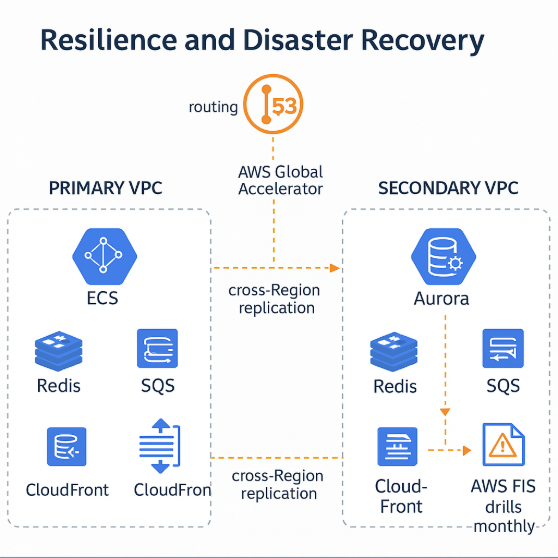
LMSA is built for continuous operation with robust recovery
measures, ensuring uninterrupted shopping experiences even during
significant disruptions such as regional outages or infrastructure failures:
High Availability Design
-
Redis clusters run in
MultiAZ replication mode with snapshot backups for
durability.
-
SQS FIFO queues integrate
DLQs and automatic retries to ensure reliable message and
event delivery across SyncFactory workflows.
-
Aurora PostgreSQL deployed in
MultiAZ configuration with
automated failover to standby nodes.
-
MongoDB Atlas leverages
multiregion cluster replication for CMS/unstructured
data.
-
OpenSearch Service configured with
multiAZ domain replication, preventing query downtime
during AZ loss.
-
Crossregion automated snapshots applied to Aurora,
MongoDB, and Redis snapshots provide protection during regional DR
scenarios.
Disaster Recovery Strategy
-
Complete application stacks provisioned in multiple AWS
regions enable regional failover for business continuity
in case of widespread outage.
-
DR testing is conducted biannually, validating failover
procedures and identifying operational improvements.
- Recovery objectives defined and validated:
-
RTO < 30 minutes for full regional outage recovery.
-
RPO < 5 minutes for order database transactions via
Aurora + Redis snapshotting.
-
Detailed DR runbooks guide operators through failover,
data restoration, and incremental sync resolution steps
Continuous Testing
-
AWS Fault Injection Simulator (FIS) runs controlled
experiments (e.g., ECS task crashes, Redis shard failures, Aurora
failovers) to validate system resilience.
-
Chaos engineering principles applied to identify single
points of failure and improve redundancy models.
-
Game days simulate peaktraffic incidents, SQS backlog
build-up, and SyncFactory webhook delays to stresstest team response and
automation.
-
Post-incident RCAs lead to continuous refinement of
Terraform modules, runbooks, and monitoring rule sets.
-
Quarterly backup and restore drills validate recovery
across Aurora, Redis, MongoDB, and OpenSearch, ensuring production-level
readiness
Financial Management and Monitoring
LMSA integrates
comprehensive financial governance practices to ensure
cost-effective scaling for dynamic retail workloads while maintaining
predictable unit economics:
Cost Governance and Forecasting
-
Predictive Financial Planning: Leveraged
AWS Pricing Calculator and TCO models to
project 3/6/9-month costs under seasonal sales loads, enabling Leroy
Merlin to budget for holiday campaigns and regional expansions.
-
Tag-Based Cost Allocation: Implemented a
strict tagging strategy (Environment, Service, Owner,
Region, CostCenter) with exports into
AWS Cost & Usage Report (CUR), enabling chargeback
across teams (Catalog, Orders, Payment, CMS).
-
Proactive Variance Analysis: Monthly
FinOps variance reviews identify unused/oversized
workloads and rebaseline cost models. Early actions drove a
~21% reduction in projected annualized costs.
-
Environment-Based Budgeting: Separate budgets and alerts
defined per Dev, QA, and Prod accounts to monitor
spending at environment level, aligned with governance cost targets
Cost Optimization Implementation
-
Provisioning Mix: Adopted a balanced compute approach
— baseline ECS workloads covered with
Savings Plans/Reserved Capacity, with
OnDemand scaling provisioned only at traffic spikes
(holiday sales events). This reduced compute spend by
~35% compared to pure On-Demand.
-
Storage Tiering Automation: Configured
S3 lifecycle policies across multiple tiers: frequently
accessed data in Standard, archived logs in Intelligent-Tiering/Glacier.
-
Idle Resource Detection:Trusted Advisor + Config rules automatically detect idle
ECS tasks, unused EBS snapshots, orphaned load balancers, triggering
SSM automation cleanup jobs.
-
Rightsizing Reviews: Aurora PostgreSQL read replicas and
Redis shards are evaluated monthly against utilization
metrics, reprovisioned based on observed demand
Real-Time Financial Monitoring
-
Budget Alerting Framework:AWS Budgets set with thresholds (70%, 85%, 95%), piping
notifications through
SNS → Microsoft Teams → Finance/Ops channels
for real-time awareness.
-
Cost Anomaly Detection:AWS Cost Anomaly Detection (ML-driven) identifies sudden
spikes (e.g., misconfigured sync jobs or OpenSearch index growth) within
hours, preventing monthly bill surprises.
-
Executive Dashboards: Custom
CloudWatch + Grafana FinOps dashboards correlate traffic
KPIs (active users, orders placed, personalized searches) with AWS
consumption, providing leadership with
cost-per-checkout visibility.
-
Continuous Optimization: Quarterly
FinOps governance boards review idle resources, adjust
provisioning models, and validate previously applied optimizations to
ensure sustained efficiency
Outcome:
This financial governance framework
enables LMSA to
scale predictably with minimal cost sprawl while supporting
growing retail demand. Even at tested loads of
10,000 users with 2,000 concurrent sessions, LMSA
maintained cost-per-transaction predictability, ensuring
profitable operation under heavy retail workloads
The Result
The Leroy Merlin Shopping Application (LMSA) represents a
sophisticated implementation of AWS technologies tailored
to the challenges of
large-scale, real-time retail ecommerce. By leveraging
microservices on ECS Fargate, managed data services (Aurora PostgreSQL,
Redis, MongoDB Atlas, OpenSearch), and eventdriven sync orchestration
(SyncFactory), LMSA delivers a
resilient, performant, and costefficient shopping experience
across regions.
Key achievements of this implementation include:
-
Scalable user load testing: Seamlessly supported
10,000 simulated users with 2,000 concurrent shoppers,
maintaining sub150ms checkout and search response times.
-
Personalized experiences: Integrated
AIdriven product recommendations (via Dynamic Yield +
OpenSearch) increased product clickthrough and conversion rates by
~30%.
-
High availability architecture:MultiAZ deployments for
Aurora, Redis, MongoDB Atlas, and OpenSearch combined with DR policies
deliver 99.99% service availability.
-
Comprehensive security:Endtoend encryption, IAM least
privilege enforcement, and SOC2aligned compliance frameworks protect
customer and payment data.
-
Cost optimization at scale: Predictable, uniteconomics
leveraged via
Reserved/Savings Plans, rightsizing, S3 lifecycle policies, and FinOps
governance, reducing projected annual spend by ~21%.
This solution demonstrates our capability to
design, implement, and operate enterprise-grade, cloud-native retail
platforms. LMSA harnesses
AWS’s extensive service portfolio to provide
exceptional customer experience, resilience, and security
— while ensuring
cost efficiency and operational transparency for Leroy
Merlin’s business stakeholders.
Appendix A — Standard RACI Matrix (VirtualIntros Compliance & Auditing)
Use this baseline with standard roles. R=Responsible, A=Accountable,
C=Consulted, I=Informed.
| Control / Activity |
Environment |
Project Manager |
Team Lead |
Solution Architect |
DevOps Engineer |
DevOps Lead |
DevOps Manager |
| CloudTrail multi-Region account trail enabled and verified |
All |
I |
I |
C |
R |
C |
A |
| AWS Config aggregator + conformance packs management |
All |
I |
I |
C |
R |
C |
A |
|
S3 log bucket hardening (encryption, versioning, access logging,
Object Lock)
|
Prod |
I |
I |
A |
R |
C |
I |
| KMS CMK management & key rotation policy |
Prod |
I |
I |
A |
R |
C |
I |
| Quarterly IAM access reviews (incl. break-glass) |
All |
I |
I |
C |
C |
R |
A |
| SCPs/guardrails (AWS Organizations) and account baselines |
All |
I |
I |
A |
R |
C |
I |
| CI/CD gates: Terraform plan/apply, Tflint scans, image signing |
All |
I |
C |
C |
R |
A |
I |
| Change management (approvals, change calendar, rollback) |
All |
A |
R |
C |
I |
C |
I |
| Datadog monitors, dashboards, alert routing (SNS -> Teams) |
All |
I |
C |
C |
R |
A |
I |
| Configuration drift detection & remediation (Config + SSM) |
All |
I |
I |
C |
R |
C |
A |
| Backup verification & DR testing (RTO/RPO) |
Prod |
I |
C |
C |
R |
A |
I |
| Incident response (triage, RCA, corrective actions) |
All |
I |
A |
C |
R |
C |
I |
| Vulnerability & misconfig detection in pipeline (Trivy) |
All |
I |
I |
C |
R |
A |
I |
| Compliance exceptions (approval, expiry, compensating controls) |
All |
A |
I |
C |
I |
R |
C |
| Monthly compliance posture reporting |
All |
A |
I |
C |
C |
R |
I |
| Evidence pack assembly for audits |
All |
A |
R |
C |
C |
C |
I |